
Translation notice
This page was translated with machine translation and may contain inaccuracies. If you can help improve it, please open an issue or submit a pull request.
The ultimate storage principle of data pack - what is SNBT
This tutorial is a simple and in-depth nanny-level tutorial on the method of storing composite variables in data pack (by xiaou0)
Since you want to introduce the concept of numerical tags, you still have to speed through it first. BEplayer is most envious/datainstruction.
/dataThe grammatical structure is first composed of two enumeration subcommands:
/data +	get		+	block	+	...
		merge		entity
		modify		storage
		remove
The first level of enumeration{get,merge,modify,remove}Indicates the operation you want to perform, the second level of enumeration{block,entity,storage}Indicates the object you want to operate on.
Putting aside the first level of enumeration, let’s first explain the meaning of the second level of enumeration, that is,
Where can tags be stored?
block ——blockentity
blockentity is a concept in the game. It refers to a block with an entitytag. Let’s not go into the difference between entitytag and non-entity status here (you probably know that one is using{}to install, the other is to use[]Just install it)
For example, boxes, funnels, and command blocks are common blocks with the property of "blockentity"—yes, I prefer to describe blockentity as a property of a type of block itself, rather than a popular type of block. There are subtle differences between the two descriptions.
entity——entity
entity, in layman’s terms, can be/killObject. As far as I know, all entities have entitytags (please point out any counterexamples).
For example. player, cow, zombie, bow and arrow, display entity.
storage - storage
storage, more intuitive than the first two, in fact,storageThe tags in can be regarded as global variables of the archive, and are also the storage locations that are considered the most priority when storing values.
At the same time,storageIt has the broadest storage conditions: you can insert any value in the root tag. Unlike entity, if you want to insert custom data, you can only insert it indataProceed under the sub tag. The
storage location will be defined the first time it is accessed, so there is no need to worry about object definition.
After introducing where to store data, it is much more convenient to introduce the data storage method. General syntax WIKI, here is only a concise and concise description:
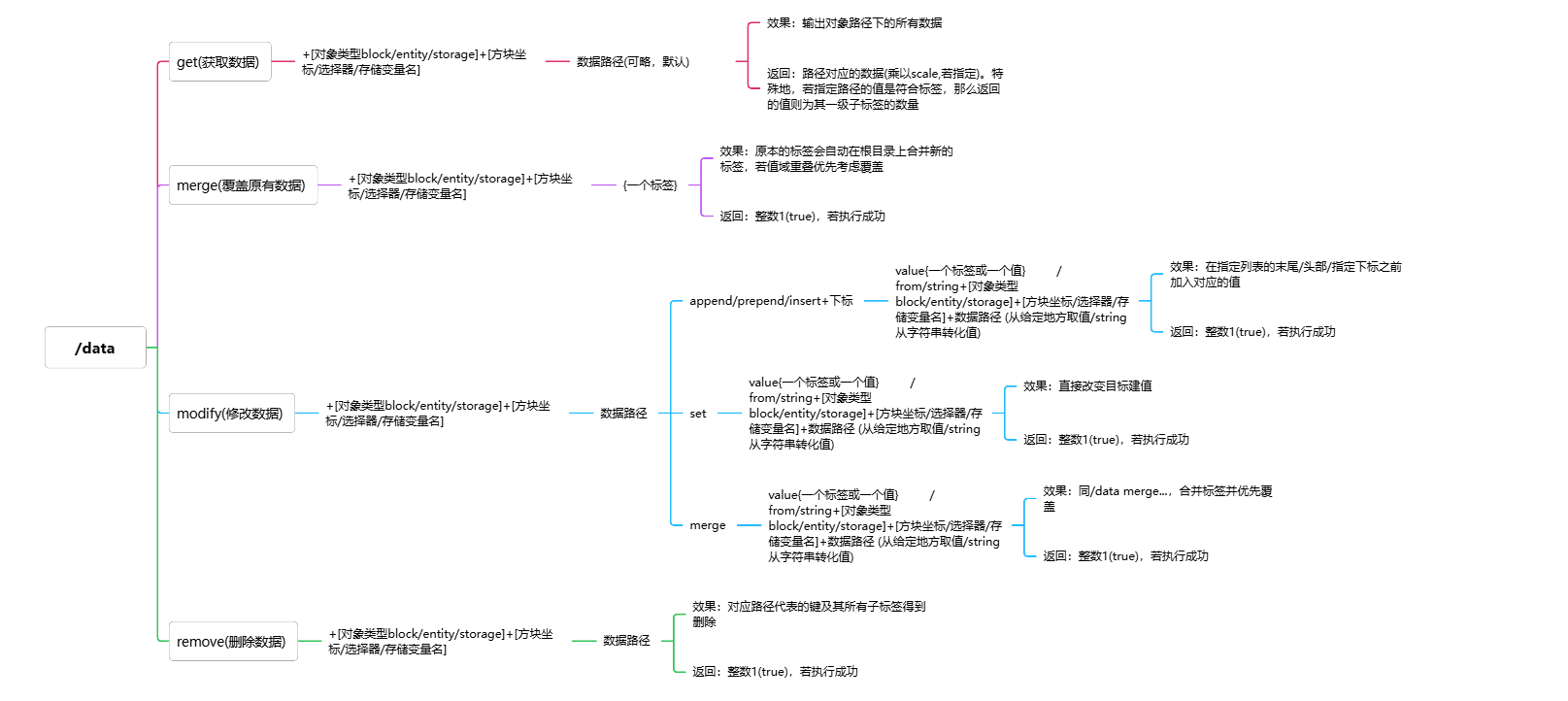
So here, related/dataThat’s it for the grammar part. If you still don’t understand some of the terms, don’t worry, you’ll have a clear understanding when you come back after reading the entire article.
What are Key-Value Pair and SNBT (Stringified Named Binary Tag)
About key-value pairs, Mengcha’s video has very detailed instructions, here I will make a few additions: the key-value pair in
MC, the key name part before the colon can be plain texta:1d, or it can be a string enclosed in quotes"b":2f,'c':"xiaou0", the two narrative methods are basically equivalent. The only difference is that when there are individual symbols in the key name (such as:), you need to put quotation marks to avoid ambiguity.
So what is SNBT
Of course, if you want to learn data pack systematically, JSON is definitely one of the required courses, and the format of JSON is similar to SNBT (JSON tutorial moves here)
Simply put, there are 3 completely different concepts in SNBT:
Single value structure
The most basic structure in SNBT is represented by a single value - this single value can be of the following types:
Byte type (`
- b
): an integer between -128 and 127 (= 8 bit = 1 byte`)
Unsigned byte type (`
- ub
): an integer from 0 to 255 (= 8 bit = 1 byte`)
Short integer (`
- s
): an integer from -32768 to 32762 (= 16 byte`)
Unsigned short (`
- us
): an integer from 0 to 65535 (= 16 byte`)
Integer type (ior no special symbols):Integers in (= 32 byte)
Unsigned integer (ui):Integers in (= 32 byte)
Long integer (l):Integers in (= 64 byte)
Unsigned long integer (ul):Integers in (= 64 byte)
Single precision floating point type (f): no more than32 byteThe rational number
double precision floating point type (d): no more than64 byteThe rational number
string(""或''): A string composed of Unicode characters
Objectively speaking, strings are also classified as linear structures. However, strings in MC do not support subscript access, so they are classified as single values
Editor's words: Strings in mc can be accessed using the string subcommand for subscript access.
Linear structure
A structure composed of multiple sibling values and tags.
There are two types of linear structures in SNBT:
Key value set, consisting of{}Identity, a set composed of multiple sibling elements. Note that because it is a set, it is unordered, while a list is ordered.
Each comma-separated value of the value set is called an element of the value set.
The key name of the value set must satisfy uniqueness, that is, one key can only correspond to one value.
Therefore, the values in the value set can be uniquely represented by key names, such asset:{a:1,b:2}middle,set.aIt meansaThe value is 2. Note the dot between the key names..separated.
List, essentially the List array in java, it supportssubscript access, andThe element search corresponds to SNBT, which is those enclosed by square brackets[]enclosed things.
Each comma-separated value in the list is called an element of the list.
In the latest version, the type restriction of the list has been lifted, and the elements of the list can be of different types, or subtags of different structures.
(this also results in{}The gap between compound tags and lists is further reduced, and lists are equivalent to tags which have an advantage, namely orderliness)
In a list, all elements are arranged in a column in order and have a label. This label is generally called subscript. It is worth noting that the value range of the subscript israther than, where n is the number of elements.
For example, in the listlist:["a","b","c"]middle,list[0]The corresponding value is"a",list[1]The corresponding value is"b",list[2]The corresponding value is"c"
In particular, there are lists of specified types, generally written as[I;...]inIRepresents an integer type. The same applies if it is replaced by other types.
The list also supports key-value access, provided that the key value points to a unique tag, for examplelist:[{name:"a",age:1},{name:"b",age:2}]middle,list[{name:"a"}]The tag pointed to is{name:"a",age:1}This whole tag.
Composite structure
I would like to give an example, SNBT tag (Note: There is no line break and indentation when writing it. If you want to wrap the line, you need to type it in the data pack.\to prompt)
{
	name:"_u0_",
	age:16,
	friends:[
		{name:"u_0_",age:114514},
		{name:"u0___",age:1919810},
		{name:"TheColdPot",age:15}
	]
} can always be clearly written in tree form:
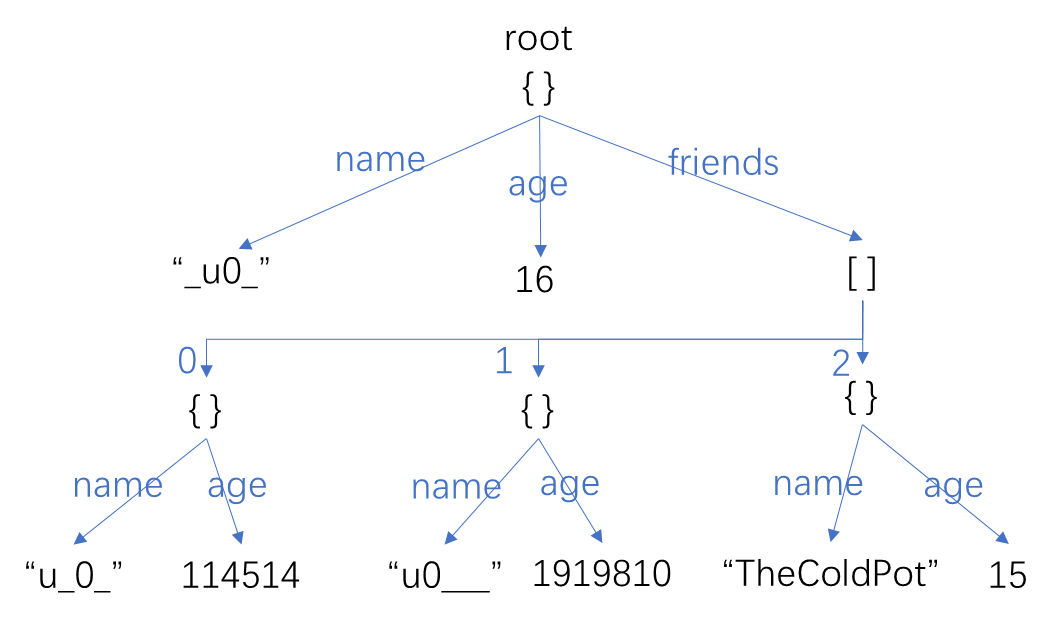
At this point, we have officially revealed the essence of SNBT: it is a rooted tree composed of edges with key names.
We define the concept of siblings, that is, two sub-tags with the same "father" tag are at the same level.
It is not difficult to find that elements at the same level are all linear structures, and this structure in which multiple structures are connected through a tree-like "parent-child" relationship is a composite structure.
After understanding the composite structure, we might as well consider how to get the value of the composite tag?
is very simple, because each key name of each substructure has a unique value. It can be proved by induction that a unique combination of key names can determine the unique value on the tree.
corresponds to SNBT in string form. You only need to find all the key names (or list subscripts) before the corresponding value, and then stack them "buff" -
For example, I want to know the age of Leng Guojiang, then we first locate his position in the composite structure:
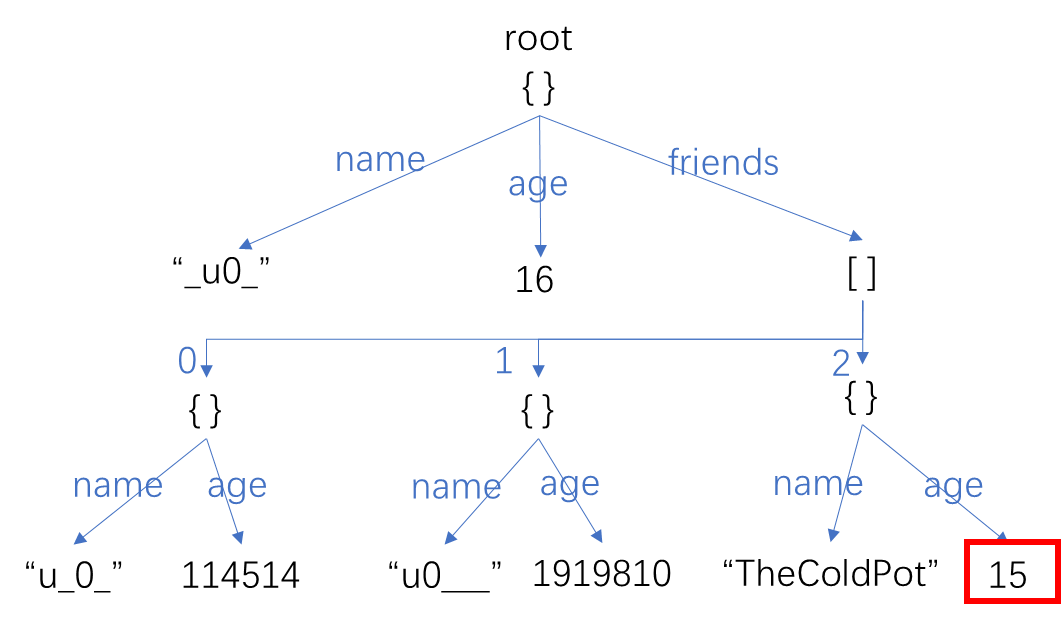
and then find its path to the root node from bottom to top:
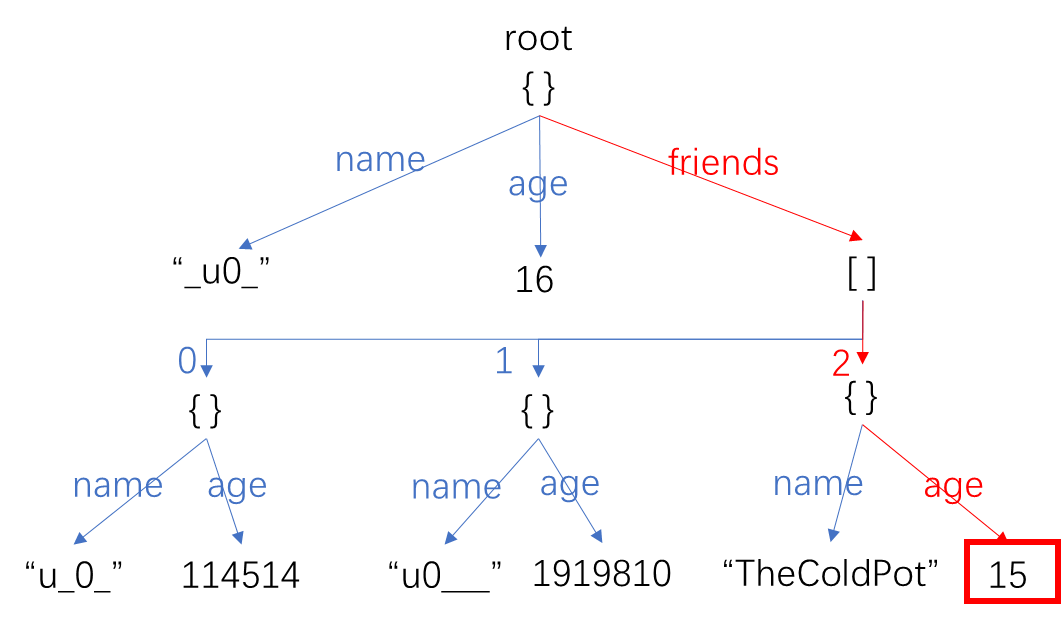
So obvious,friends[2].ageThis is the key name we are looking for.
Some miscellaneous knowledge you may want to know
- For compound structures, maintenance complexity is strongly affected by the depth of the tree. Therefore, when there are only a few keys,
list:[{a:1,b:2},{a:2,b:3}]is better written aslista:[1,2],listb:[2,3]. - When using
/execute iffor data matching, only the values on the specified path are matched. In particular, if the value is a list, only the target list is matched in order. - Little u0 is really 16 years old.