
Translation notice
This page was translated with machine translation and may contain inaccuracies. If you can help improve it, please open an issue or submit a pull request.

TheSkyBlessingdata pack analysis part two
Preface
OhMyDat is a wheel attached to the TSB project for processing entity private data. It uses a complexity ofO(1)The algorithm allocates an independent freely readable and writable data space for each execution entity. Its important roles in maps include:
- Back up entity data and identify the data time of a certain game based on a timestamp to avoid high-frequency use.
datacommand reads entity data - Use concepts similar to programming objects to store some customized entity data, such as buffs defined in the game and panel data such as the entity's attack power resistance.
Let’s do a quick chant before officially starting this article. TSB is a map work with high playability and technical content. Interested readers are recommended to play it on their own. It involves third-party works, so the source data pack will not be fully attached. These contents and the data pack tutorial provided by the map production team can be found in TSB’s warehouse.
Data pack introduction
How to understand private data storage? In a programming language that supports object-oriented programming, the data owned by each instance object is independent. Although each instance object has the same data format, each other's data is stored separately on the instance.
In MC data pack, there are similar features like
- The scoring items of the scoreboard. The mapping relationship of "entity - score" can be realized. The score can be regarded as the private data of the entity, but the format must be an integer and cannot store complex structures.
- Entity's NBT data supports complex structures and
datacommand operation, but high-frequency reading and writing will significantly consume performance.
So there is OhMyDat's solution, whose function is described in one sentence - Construct a unique mapping relationship of "entity-command storage", thereby allocating exclusive and independent command storage space to each entity. As a wheel data pack (or tool data pack), its exposed usage is very simple. It has been briefly introduced in the previous analysis, and I will mention it again here:
# 使用前执行please函数(函数的执行者必须是要存储数据的实体)
function #oh_my_dat:please

# 获取数据存储
data get storage oh_my_dat: _[-4][-4][-4][-4][-4][-4][-4][-4].DataName

# 修改数据存储
data modify storage oh_my_dat: _[-4][-4][-4][-4][-4][-4][-4][-4].DataName set value DataValue

# 删除数据存储
data remove storage oh_my_dat: _[-4][-4][-4][-4][-4][-4][-4][-4].DataName
The main structure can be summarized into three parts
OhMyDayIDscoreboard- In the system, each entity has an independent ID used to find its data space. The score on the scoreboard is the data space ID assigned to the entity.
- An array of ids in command storage
- It can also be called the ID queue. The IDs in the ID scoreboard will also be stored in this array for the allocation of new IDs. The newly allocated IDs will be added to the end of the array. It should be noted that the scoreboard and the data in this array are not necessarily synchronized.
- An eight-dimensional array in command storage
- The location where the entity data space is stored. All entities that have been assigned IDs have their own data space in this multi-dimensional array. The index number of this data space can be obtained by calculating the entity ID.
The main functions include the following
please.mcfunction- Assign an ID to the function executor and obtain the data space, or obtain the existing data space based on the ID
allocate.mcfunction- Assign an ID to an entity without an ID
gc.mcfunction- Clean up invalid IDs and corresponding data spaces in the system when allocating IDs
provide.mcfunction- After passing in the entity ID, search the corresponding data space based on the ID.
The workflow of several modules of the entire system is as follows. The following will also introduce the three modules of ID allocation, ID cleaning, and ID search data space.
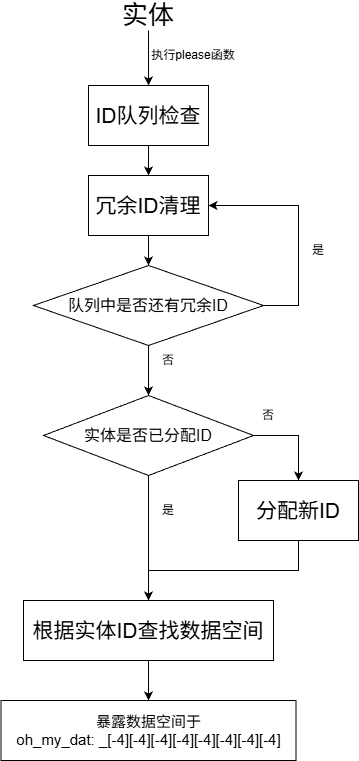
Assign new ID
When you first enter the game, the id scoreboard is empty, and there is only one 0 in the id array. Execute for playerpleasefunction, since the player does not have an id on the id scoreboard, you need to assign an id to the player first, using the existing id in the id array as the standard. The process of assigning id is as follows
- Move the first bit of the array to the end
- Get the new id according to the formula of (the first digit of the array + the last digit of the array)/2
- The new id is added to the end of the array
- Synchronize the id to the player's scoreboard score
When there are enough ids allocated, the ids will get smaller and smaller according to the above formula. However, since the new ids are calculated based on the existing ids, all ids will not be repeated. When the end of the array is0, this bit will be replaced by the maximum value of the assignable ID65536Make the new id larger to ensure that it does not exceed the maximum value65536. Let’s further understand this process with examples from just entering the game.
- Just after entering the game, the data pack is initialized. The id array is [0]
- Execute with player as executor
pleasefunction, get the first place0and the last one0, the last one is0So it was replaced by65536 - The player's id is calculated as
- Update the player's id score item and add it to the id array. At this time, the id array is
[0, 32768] - Synchronize the id to the player's scoreboard score

Since the array has only one element, there is no need to shift. At this time, the execution continues for another entity.pleasefunction
- First move the first 0 to the end to get the first digit
32768and the last one0,0is replaced by65536 - The calculated id of the entity is
- Update the id score item of the entity and add it to the id array. At this time, the id array is
[32768, 0, 49152] - Synchronize the id to the scoreboard score of the entity

Then execute for another entitypleasefunction, repeat the above process

Execute again

The above has vividly demonstrated how the system allocates IDs to mobs. There is only one person responsible for allocating IDs.allocatefunction, its content is also very simple, the queue rotation part is ingcfunction, which is completed in the part of recycling invalid ids.
——————allocate.mcfunction——————

function oh_my_dat:sys/gc

# 获取id数组的第一位和最后一位,作为新id的参考值
    execute store result score $ OhMyDatID run data get storage oh_my_dat: id[-1]
    execute store result score $ OhMyDat run data get storage oh_my_dat: id[0]

# 如果最后一位是0则改为65536
    execute if score $ OhMyDatID matches 0 run scoreboard players set $ OhMyDatID 65536

# 新id为数组第一位和最后一位之和除以2
    scoreboard players operation $ OhMyDatID += $ OhMyDat
    scoreboard players set $ OhMyDat 2
    scoreboard players operation $ OhMyDatID /= $ OhMyDat

# 将新id同步到id数组和执行者的计分项中
    data modify storage oh_my_dat: id append value -1
    execute store result storage oh_my_dat: id[-1] int 1 run scoreboard players get $ OhMyDatID
scoreboard players operation @s OhMyDatID = $ OhMyDatIDidIt will be added to the array and the scoreboard score of the entity at the same time, but as mentioned earlier, the scores of the two are not synchronized. The scoreboard score of the entity will be removed after the entity is cleared, but the id array is in the command storage. At this time, the id array generates a redundant id. If there is data in the entity's data space, these data will become useless data. For this purpose we have introduced the following module function for recycling IDs
Recycle invalid id
The function of recycling invalid IDs will be executed every time before allocating an ID to a new entity. In order to facilitate understanding of its function, this function is executed separately for demonstration.
Three IDs have now been assigned to three entities:32768、16384and49152, these IDs are also recorded in the playerIDon the scoreboard and added to the ID queue.
Now the kill ID is16384entity, entity inIDThe scores on the scoreboard will be cleared, but16384This ID still exists in the ID queue, and this ID is an invalid ID at this time.
Execute nowgcfunction (Garbage Collection, abbreviation for garbage collection), the ID queue is rotated in the same way as when allocating new IDs, invalid IDs16384It was pushed to the head of the queue and was detected as an invalid ID, so it was removed from the ID queue and its corresponding data space was also cleared. After a series of operations, the calculated new entity ID is added to the end of the queue:

The above process sounds complicated, but there is actually only one core idea, which is how to identify an invalid ID when it is pushed to the top of the queue. To further simplify our needs, the essence of invalid ID is that the original entity does not exist.IDThe data in the scoreboard and ID queues are out of sync, so the question becomes how to determine whether an ID is still on the scoreboard.
Due to the limitations of MCcommand, it is cumbersome to directly traverse the entire list like a programming language. However, MC's scoreboard still has some functions that are convenient for operating on the entire list. For example, the asterisk (*) can operate on all targets being tracked by the scoreboard. Combined withoperationWith the comparison operator in command, we can quickly find the largest or smallest score from the scoreboard:
# 将所有被追踪目标在A记分板上分数增加100
scoreboard players add * A 100

# 将A记分板上最小的分数赋值给Steve
scoreboard players operation Steve A < * A
These simple functions plus some ingenuity of the original author resulted in the following method for determining whether an ID is still on the scoreboard.
- ID to be detected minus
2147483647as reference value - right
IDAll scores on the scoreboard minus the reference value - Get
IDThe biggest score on the scoreboard - Add the maximum score obtained back to the reference value to get the restored ID, for
IDAll scores on the scoreboard perform the same operation - Determine whether the ID to be detected is greater than the restored ID. If so, the ID to be detected is an invalid ID.
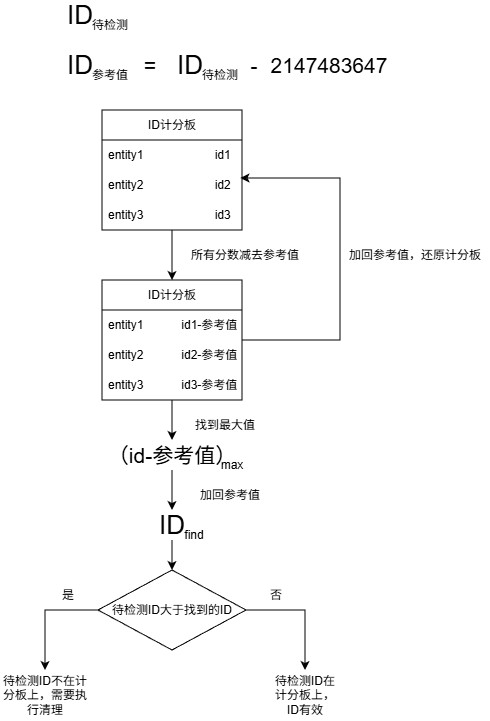
2147483647It is the integer upper limit of the scoreboard score. According to the rules of integer overflow, when the value exceeds this upper limit, it will become a negative number:
Now assuming that the scoreboard has the ID we want to detect, then the score will change as follows during the operation of the entire scoreboard:
Since no fraction can be greater than2147483647, so at this time** as long as the maximum score of the scoreboard obtained is equal to2147483647It can be considered that the ID to be detected exists on the scoreboard**. This part of the function is implemented as follows
——————gc.mcfunction——————

# 取队列第一位作为校验ID
    execute store result score $ OhMyDat run data get storage oh_my_dat: id[0]

# 减去2147483647作为参考值
    scoreboard players remove $ OhMyDat 2147483647

scoreboard players set $ OhMyDatID 0

# 记分板上所有计分项减去参考值
    scoreboard players operation * OhMyDatID -= $ OhMyDat

# 找到记分板所有计分项的最大值
    scoreboard players operation $ OhMyDatID > * OhMyDatID

# 还原记分板
    scoreboard players operation * OhMyDatID += $ OhMyDat
    scoreboard players operation $ OhMyDat >< $ OhMyDatID

# 取待校验ID和刚才找到的记分板最大值进行比较,如果大于这个最大值,则说明这是一个无效的id,执行清理
    execute store result score $ OhMyDatID run data get storage oh_my_dat: id[0]
    execute if score $ OhMyDatID > $ OhMyDat run function oh_my_dat:sys/gc_loop
On the contrary, if the maximum value obtained is not2147483647, then there are two situations. The ID before transforming the scoreboard may be greater or less than the ID to be detected, which are recorded asand, the results after the two ID transformations are as follows
Since the range of ID allocation is the same as in the above formulaThe range is in ~ , so according to the above results, it can be known that an ID larger than the ID to be detected will become a negative number close to the limit, and an ID smaller than the ID to be detected will become a positive number close to the limit.
If the ID to be detected is not on the scoreboard, then the maximum value of the scoreboard found at this time corresponds to the ID in the ID array that is one smaller than the ID to be detected. At this time, it can be determined that the ID to be detected is not in the scoreboard and should be cleared. At the same time, other IDs larger than this value in the ID array should also be cleared (otherwise the highest value found does not correspond to it). So ingc_loopIn the function part, in addition to cleaning up invalid ids and their corresponding data spaces, the same operation will be performed recursively on the next bit in the queue:
——————gc_loop.mcfunction——————

# 清理id对应的数据空间,并移出id队列
	function oh_my_dat:sys/provide
	data modify storage oh_my_dat: _[-4][-4][-4][-4][-4][-4][-4][-4] set value {}
	data remove storage oh_my_dat: id[0]

# 递归查找队列的下一位
	execute store result score $ OhMyDatID run data get storage oh_my_dat: id[0]
	execute if score $ OhMyDatID > $ OhMyDat run function oh_my_dat:sys/gc_loop
Get data space based on id
Introduction to multidimensional arrays
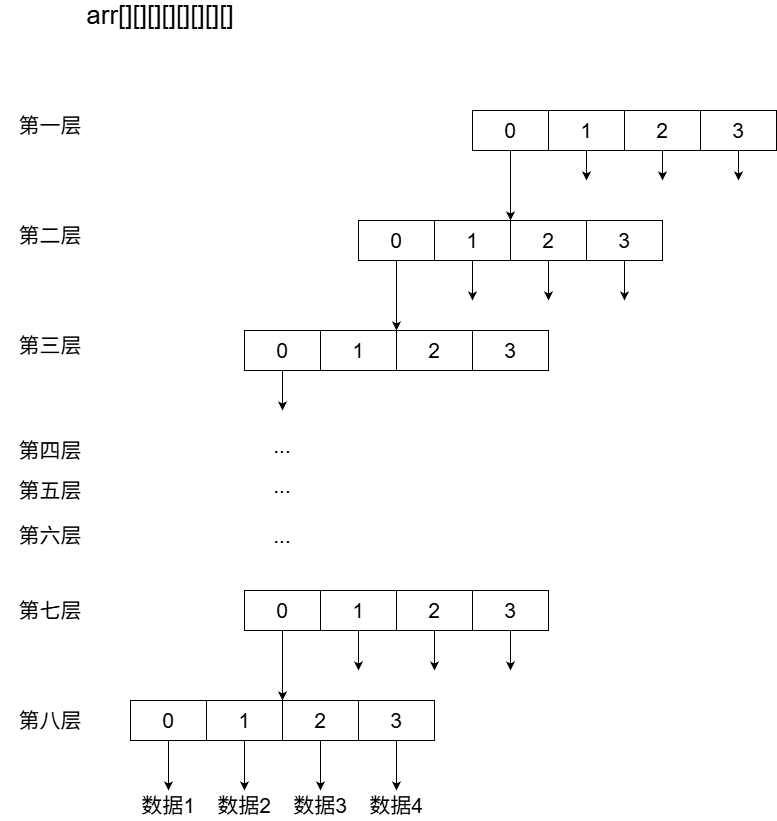
As mentioned earlier, an eight-dimensional array in command storage is responsible for managing all entity data spaces.
First, let’s introduce the concept of multidimensional arrays. To give the simplest example of an array,arrThe array is[100, 101, 102, 103], index number0arrive3Each corresponds to an element in an array,arr[0]The corresponding data is100。
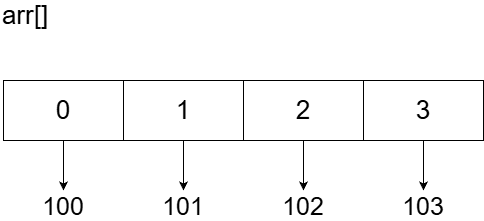
After turning the array into a multi-dimensional one, the index number of each layer of the array will correspond to a new array, and the data will be stored in the end array. Taking a two-dimensional array as an example, a two-dimensional arrayarrThe definition format is[[100, 101, 102, 103],[],[],[104, 105, 106, 107]]. Perhaps it would be more intuitive to write it in the following tree shape:
[
    [100, 101, 102, 103],
    [],
    [],
    [104, 105, 106, 107]
]
In this two-dimensional array,arr[0]andarr[3]is an array with four elements,arr[1]andarr[2]are two empty arrays. If I want to get100For this data, its index number isarr[0][0],107Then it isarr[3][3]
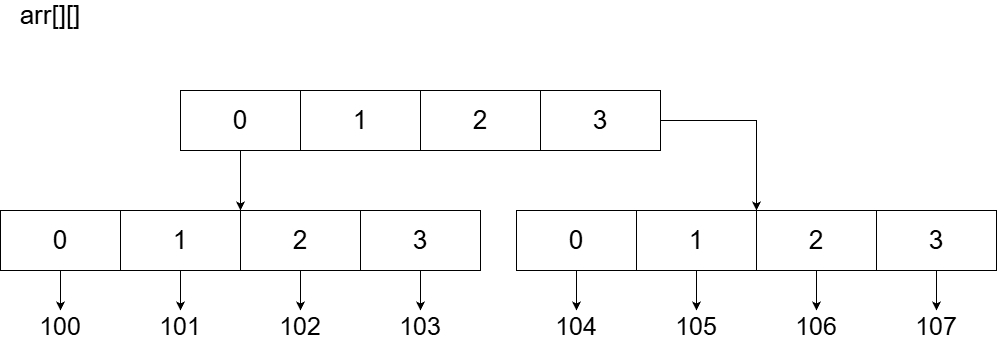
In the above array example, an empty array is inserted. The number of elements in each layer of the multi-dimensional array is different. The multi-dimensional array at this time is a non-rectangular array, and the eight-dimensional array used by OhMyDat is a rectangular array, which means that each layer of the array has the same number of elements. For a rectangular array, the maximum amount of data stored is the square of the number of elements in each layer and the array dimension.
In the above introduction of assigning IDs to entities, we already know that the upper limit of IDs assigned to entities is, the special meaning of this number is that it can also be written as. The eight-dimensional array to be used to store the data space conforms to the matrix array rules and the elements of each layer are, so its maximum storage quantity is also, which corresponds to the maximum ID that can be allocated, so that each entity that has been allocated an ID can have a completely independent data space in the eight-dimensional array.
Convert ID to array index
After understanding how multi-dimensional arrays work and the correspondence between ID and multi-dimensional arrays, the next task is how to find the corresponding data space in this eight-dimensional array based on the entity ID. In order to avoid confusion, let's get used to the way eight-dimensional arrays are written.
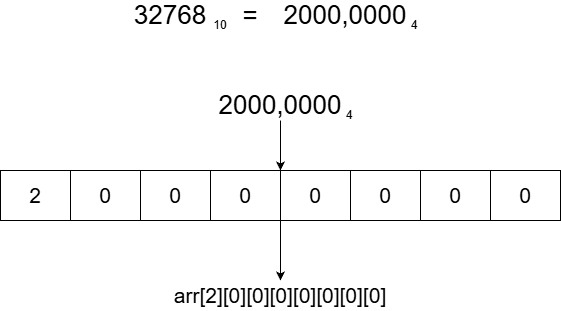
When the program to find the address is running, the decimal ID of the entity will first be converted into a quaternary ID, and the first ID assigned when entering the game will be used.327689For example, the corresponding quaternary number is2000,0000, the corresponding address in the eight-dimensional array is as follows. Similar logic, the maximum value of entity ID is65535, then its address in the eight-dimensional array isarr[3][3][3][3][3][3][3][3]。
The above introduction is very vivid, but the implementation through MC instructions is not as direct as the diagram. The actual digital decomposition process is as follows:
- Multiply the ID value by
65536(), get the first layer offset - multiply the result by, get the second layer offset
- multiply the result by, get the third layer offset
- ……
- multiply the result by, get the eighth layer offset
The value range of Minecraftscoreboard score is`
- 2147483648
~2147483647($-2^{31}$ ~ $2^{31} - 1$), the baseline value for ID allocation is65536($2^{16}=4^8$),WillID`After multiplying the value by the base value, the value can be enlarged to the entire value range. At the same time, the value range can be divided into four core intervals, each interval corresponding to a digit offset of the quaternary number (that is, the value of the corresponding digit of the quaternary number, and also the index value of the corresponding dimension in the eight-dimensional array)

every timeIDTo perform multiplication by four, essentially multiplyIDThe quaternary number is shifted one bit to the left, even if the operation result exceedsThe bit integer range triggers numerical overflow, and the final result will still fall within the four preset intervals. pass judgmentIDThe interval to which it belongs can determine the offset size of the current digit, and then map the offset to the index of the corresponding level in the eight-dimensional array. This method was also used in the previous article when dealing with experience bars:
byIDfor9999For example, it is known that the decimal to quaternary number is2130033. The digital decomposition operation process is as follows:
- , in ~ interval, corresponding offset
0 - , in ~ interval, the corresponding offset is
2 - , in ~ interval, corresponding offset
1 - , in ~ interval, corresponding offset
3 - (Other digits can be deduced in the same way)
Get data space based on index
Through the above digital decomposition process, we have obtained the index number of the entity ID in the eight-dimensional array after conversion. By passing the index number into the array, we can get the entity data space we want to obtain. However, unless a macro is used, the MC instruction does not provide a method of directly passing the index into the array. Therefore, there is the following method of locating elements through negative indexes:
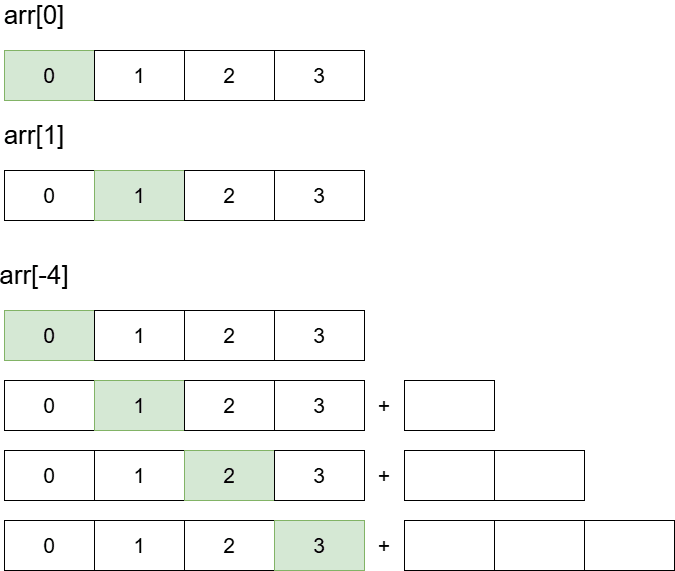
arr[-4]Represents the fourth element of the array from back to front. Without changing the original array data, you can add empty elements at the end of the array, and add a specified number of empty elements according to the index number you need to obtain, soarr[-4]This allows us to accurately point to the element we want to locate.
Still withIDfor9999Take the entity as an example. We already know that its quaternary system is2130033, then the corresponding array index isarr[0][2][1][3][0][0][3][3](Note to complete thebit), the process of obtaining the data space is as follows:
- The first one is
0, then no empty elements will be appended, the first levelarr[-4]point toarr[0] - The first one is
2, then towardsarr[-4]This array appends two empty elements, and the second levelarr[-4][-4]Point to the originalarr[0][2] - The first one is
1, then towardsarr[-4][-4]This array appends an empty element, and the second levelarr[-4][-4][-4]Point to the originalarr[0][2][1] - The first one is
3, then towardsarr[-4][-4][-4]This array appends three empty elements, and the second levelarr[-4][-4][-4][-4]Point to the originalarr[0][2][1][3] - (Other digits can be deduced in the same way)
It should be noted that since adding empty elements is performed in the entire eight-dimensional array, if you switch the object to obtain the data space, you must first clean up the previously added empty elements each time, so inprovideYou can see such a long paragraph at the beginning of the function. Its function is to clean up the last three empty elements without changing the first four bits of each layer of the array.
——————provide.mcfunction——————

# 清理空元素
	data remove storage oh_my_dat: _[-4][-4][-4][-4][-4][-4][-4][6]
	data remove storage oh_my_dat: _[-4][-4][-4][-4][-4][-4][-4][5]
	data remove storage oh_my_dat: _[-4][-4][-4][-4][-4][-4][-4][4]
	data remove storage oh_my_dat: _[-4][-4][-4][-4][-4][-4][6]
	data remove storage oh_my_dat: _[-4][-4][-4][-4][-4][-4][5]
	data remove storage oh_my_dat: _[-4][-4][-4][-4][-4][-4][4]
	data remove storage oh_my_dat: _[-4][-4][-4][-4][-4][6]
	data remove storage oh_my_dat: _[-4][-4][-4][-4][-4][5]
	data remove storage oh_my_dat: _[-4][-4][-4][-4][-4][4]
	data remove storage oh_my_dat: _[-4][-4][-4][-4][6]
	data remove storage oh_my_dat: _[-4][-4][-4][-4][5]
	data remove storage oh_my_dat: _[-4][-4][-4][-4][4]
	data remove storage oh_my_dat: _[-4][-4][-4][6]
	data remove storage oh_my_dat: _[-4][-4][-4][5]
	data remove storage oh_my_dat: _[-4][-4][-4][4]
	data remove storage oh_my_dat: _[-4][-4][6]
	data remove storage oh_my_dat: _[-4][-4][5]
	data remove storage oh_my_dat: _[-4][-4][4]
	data remove storage oh_my_dat: _[-4][6]
	data remove storage oh_my_dat: _[-4][5]
	data remove storage oh_my_dat: _[-4][4]
	data remove storage oh_my_dat: _[6]
	data remove storage oh_my_dat: _[5]
	data remove storage oh_my_dat: _[4]
The other parts are performed layer by layer for a total of eight times just like the analysis. There is an extra step to copy the structure of initial (an empty eight-dimensional array defined during initialization) to prevent the element corresponding to the index from being found.
——————provide.mcfunction——————

# 第一层
	scoreboard players operation $ OhMyDatID *= $65536 OhMyDatConst
	execute if score $ OhMyDatID matches 1073741824.. run data modify storage oh_my_dat: _ append value []
	execute if score $ OhMyDatID matches ..-1073741825 run data modify storage oh_my_dat: _ append from storage oh_my_dat: two_empty_lists[]
	execute if score $ OhMyDatID matches -1073741824..-1 run data modify storage oh_my_dat: _ append from storage oh_my_dat: three_empty_lists[]

# 第二层
	execute unless data storage oh_my_dat: _[-4][0] run data modify storage oh_my_dat: _[-4] set from storage oh_my_dat: initial[0]
	scoreboard players operation $ OhMyDatID *= $4 OhMyDatConst
	execute if score $ OhMyDatID matches 1073741824.. run data modify storage oh_my_dat: _[-4] append value []
	execute if score $ OhMyDatID matches ..-1073741825 run data modify storage oh_my_dat: _[-4] append from storage oh_my_dat: two_empty_lists[]
	execute if score $ OhMyDatID matches -1073741824..-1 run data modify storage oh_my_dat: _[-4] append from storage oh_my_dat: three_empty_lists[]
	execute unless data storage oh_my_dat: _[-4][-4][0] run data modify storage oh_my_dat: _[-4][-4] set from storage oh_my_dat: initial[0][0]

# 第三层
	scoreboard players operation $ OhMyDatID *= $4 OhMyDatConst
	execute if score $ OhMyDatID matches 1073741824.. run data modify storage oh_my_dat: _[-4][-4] append value []
	execute if score $ OhMyDatID matches ..-1073741825 run data modify storage oh_my_dat: _[-4][-4] append from storage oh_my_dat: two_empty_lists[]
	execute if score $ OhMyDatID matches -1073741824..-1 run data modify storage oh_my_dat: _[-4][-4] append from storage oh_my_dat: three_empty_lists[]
	execute unless data storage oh_my_dat: _[-4][-4][-4][0] run data modify storage oh_my_dat: _[-4][-4][-4] set from storage oh_my_dat: initial[0][0][0]

# 以此类推……
After the above steps, finallyarr[-4][-4][-4][-4][-4][-4][-4][-4]The address of is the address of the data space corresponding to the entity ID. The above series of steps have been encapsulated, so when used in the end, it will look like the initial demonstration.
function oh_my_dat:please
data modify storage oh_my_dat: _[-4][-4][-4][-4][-4][-4][-4][-4].Data set from entity @s
Unsolved mysteries
While debugging and writing, I also suffered from AI illusion many times. The inverse algorithm is indeed a big project, so the technical ideas of the original map team were really too ruthless. The above summary of good ideas is enough for reproduction, but ingcThere is also a piece of leftover content in the function that is used to control whether the function is recursive. I have never been able to see the idea, especially a calculation formula. If there are readers who can understand this algorithm, please contact me to modify it.
execute store result score $ OhMyDat run data get storage oh_my_dat: id[-1]

execute if score $ OhMyDat matches 0 run scoreboard players add $ OhMyDat 65536
execute if score $ OhMyDatID matches 0 run scoreboard players add $ OhMyDat 65536
execute if score $ OhMyDatID matches 0 run scoreboard players add $ OhMyDatID 65536
scoreboard players operation $ OhMyDat += $ OhMyDat
scoreboard players operation $ OhMyDat -= $ OhMyDatID
scoreboard players operation $ OhMyDat -= $ OhMyDatID
scoreboard players operation $ OhMyDatID -= $ OhMyDat
execute store result score $ OhMyDat run data get storage oh_my_dat: id[1]
scoreboard players operation $ OhMyDatID -= $ OhMyDat

execute if score $ OhMyDatID matches -1.. run function oh_my_dat:sys/gc
appendix
TheSkyBlessing Map Project Warehouse
GitHub - ProjectTSB/TheSkyBlessing: TheSkyBlessing のベース Datapack のリポジトリ
OhMyDat wheel data pack warehouse
GitHub - Ai-Akaishi/OhMyDat: Minecraft Private Storage Datapack