Translation notice
This page was translated with machine translation and may contain inaccuracies. If you can help improve it, please open an issue or submit a pull request.
Development experience sharing: entity tree and object-oriented
summary
This article refers to the content included in the site You must immediately abandon all world entity to use the new generation of shadow operators - Rainbow and minecraft instructions cooking guide: cold entityselector - Chuang Xiaoye Two articles share an entity management and operation method based on a similar Tree structure.
Agreement
Since the referenced article uses different names for the same concept, here we use world entity to refer to the operator in the first article, which is defined as the only object with a fixed UUID that exists in the world. The discussion of entity pointers will no longer be limited to worldentities. Any object that can serve as a quick access to another entity within the context can be called an entity pointer.
Introduction to entity pointers
The entity pointer is an object that quickly accesses another entity, usually an entity. Thanks to Mojangexecute onSubcommand to switch the executor to another entity that is related to the entity. This search is far better than the one optimized with the selector parameter.@eSoon, we will use this feature to establish connections between different objects.
In our example we usedpassengerpointers andoriginPointers, the former is a pointer with location binding, and the latter is a pure access pointer. Note that the entity tree introduced in this article is only built onpassengersBased on the pointer, this kind of pointer can ensure the legality of the tree (it has a unique root, and a passenger cannot point to its mount entity (vehicle) or the entity on other branches through the Passengers pointer)
Note that the root entity of the entity tree is currently very limited, because the root entity is unique and plays an important role, but the interpolation function of the display entity and the physical functions of most other entities cannot be combined (this may be solved after Mojang introduces the entity component). Additionally, in situations where the riding anchor is required to be non-unique, the entity tree will not be suitable for use onlypassengerPointer construction, even the entity group may no longer be a tree structure.
The core idea of entity tree
"Tree" is a concept in graph theory. It is a way of connecting nodes that satisfies:
There is only one root node (Root) and no parent node.
Each node has zero or more children but only one parent.
There is no cycle (Cycle), that is, there is no node that is both the ancestor and descendant of another node.
This is caused bypassengerPointers are naturally satisfied because each entity can only have one mount.
The entity tree uses riding relationships to make different entities a connected whole on the client and server. As long as the bottom entity (called root entity (Root)) can be accessed, all entities in the tree can be accessed through riding relationships. By executing on the root entityexecute on passengersTo access other entities on the tree, we can achieve very efficient entity access and operations. Note that there are a few entities that cannot be/rideTo control riding, these entities must be leaf entities on the tree (that is, entities without child nodes).
(command/ride - Minecraft Wiki) The command cannot be player or tag, tether knots, lightning beams and floats to add passengers.
Project examples
In order to show the advantages of the entity tree, let's first look at a complex entity usage scenario, which is also my original intention of using the entity tree method:
In this scenario, we require the user to look at an entity from a certain distance and control its behavior through input operations. Although it seems simple, it is more troublesome to implement. we need to:
Multiplayer compatibility: How can each player correspond to an entity one-to-one? We need a mechanism to ensure that each player can correctly find and operate its own entity.
Control the player: Since the player must act as a camera here, we need to introduce other entities, through
/rideThe command fixes the player's position.Operation mapping: We must first find the player in the context, process his input operations, and then find the corresponding entity to implement the operation. If used every time
@eTo find the entity, the efficiency will be very low.
It can be seen that although the problem is very simple, the specific operation is more complicated (especially when we want to use less than@e^2complexity to implement). Since the problem is very simple after abstraction, we might as well use object-oriented thinking to solve this problem.
There are two types of objects in this scene (it will be more if the communication between classes is also encapsulated. We discuss a more direct implementation here), Camera and Character. We only need to implement the functions of these two types of objects respectively and enable them to communicate with each other.
Camera class definition
The camera class needs to undertake the following functions:
Smooth motion: This requires that the entity that determines coordinates is interpolatable. Currently, only the display entity satisfies this function. We hope that the interpolation will be as smooth as possible, and the item display entity (Item Display)'s interpolation mechanism based on the current frame is very suitable for this requirement. (Different from the interpolation mechanism of block display entity). So we let the item display entity as the root entity that determines coordinates.
Imaging: Only the player itself can "see things", but due to the special nature of the player, each camera class will dynamically bind the player in the program. Therefore, we do not include the player when instantiating the class, and the camera object that operates normally must bind the player in a certain way.
Observation target pointer: The camera class needs to have an attribute to record the object it is observing. This object is an instance of the character class we mentioned above. This function can be achieved by introducing an entity pointer. We use drop (Item) here, which
ThrowerThe entity pointed to by nbt can passexecute on originfor quick access.Player pointer: The camera class needs to have an attribute to record the player it is bound to. This attribute can also be implemented by introducing an entity pointer, and can also be implemented using dropped objects.
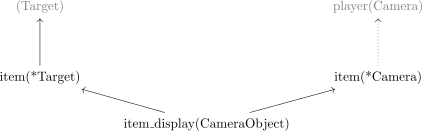
Then the various parts of the camera class are as shown in the schematic diagram: (each arrow is aexecute onoperation, despiteexecute on passengersNot a strict mapping...):
Role class definition
The role class needs to undertake the following functions:
Physical functions: The character class needs an entity to undertake physical functions, so that we can handle operations such as collision and movement. We can use entities such as player models, armor stands, dropped objects, etc. to undertake this function. (The armor stand is chosen here because it can be equipped with an item on the head to display the model facing the entity)
Display function: For a simple character, the physical function and the display function can be assumed by the same entity (such as armor stand and player model), but you can also use the display entity of Animated Java to assume the display function, usually by riding him on dropped objects, because the amount of data dropped is smaller.
Operator pointer: The character class needs to have an attribute to record its operator. This attribute can also be implemented by introducing an entity pointer, and can also be implemented using dropped objects.
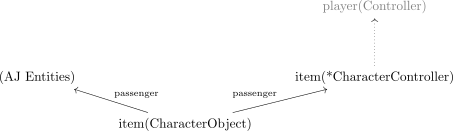
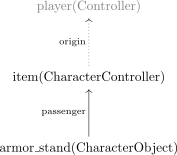
Schematic diagram:
Animated Java solution
or armor stand scheme
Class instantiation and management
Instantiating objects calls out corresponding entities and maintains information about these objects. Although it can also be usedexecute summon ... run functionto avoid using@eof use. However, for the purposes of this tutorial, we will first use@eto find entities. (In fact, object creation is not frequent, so use@eThere won’t be much performance problem if you look for entities)
Role class
Taking the role class as an example, the implementation of the initialization function is as follows:
# character:init
# 创建角色对象
summon armor_stand ~ ~ ~ {\
    Invisible:1b,\
    Tags: ["CharacterObject"],\
    attributes:[\
        {id:"step_height",base:1.0}\
    ],\
    Passengers: [\
        {\
            id: "item",\
            PickupDelay: 32767,\
            Age: -32768,\
            Item: {id: "music_disc_11", components: {"item_model": "air"}, count: 1},\
            Tags: ["EntityPointer","CharacterController"]\
        }\
    ]\
}

# 递归赋予 id
scoreboard players add #Pointer ObjectID 1
execute as @e[tag=CharacterObject,distance=..1,type=armor_stand] run function object:__assign_id
For the @e optimization guidelines here, please refer to minecraft instruction cooking guide: cold entityselector - Chuang Xiaoye about selector optimization, please note that you must not use it here.[nbt={}], when serializing and deserializing the nbt of the root entity, all passenger entities will be accessed at the same time, resulting in extremely low efficiency.
# object:__assign_id
scoreboard players operation @s ObjectID = #Pointer ObjectID
# 递归, 由于 passenger 是树形结构,所以不需要额外写条件,递归会自动在叶子节点处停下
execute on passengers run function object:__assign_id
Note: In my project, the character class actually consists of 1 root entity and 5 leaves. I will introduce other unmentioned object functions in the later part of "Building a Simple 2D Scene".
Next we need to define some methods for the entity. The first is the destruction method. This method only destroys the nodes on the tree. If your object has more than one tree, then you may need to destroy it based on the ObjectID:
# character:destroy
# 销毁整个实体树
execute on passengers run function character:destroy
kill @s
The following is the method for binding the player. This method also needs to be implemented on the camera object:
# character:method/bind_player
# 绑定玩家,假设执行该方法的上下文坐标在玩家的位置,上下文执行者则是该对象的根实体
execute on passengers if entity @s[tag=CharacterController] run data modify entity @s Thrower set from entity @p UUID
The following various methods are commonly used. Since the purpose of this article is to introduce the concept and usage of the entity tree, we will not discuss too much about the implementation details of the function:
character:method/pull_event: Capture all input events of the controller and process them.character:method/move_(direction):Move function, direction can be forward/backward/left/right/up/down or a combination of both directions.character:method/look_(direction):Turn function, direction can be left/right/up/down or a combination of both directions.- ...
Camera class
The instantiation and method definition of the camera class are similar to those of the character class, so we won’t go into details here.
# camera:init
# 创建摄像机对象
summon item_display ~ ~ ~ {\
    data: {rx: 45,ry: 30, distance: 32},\
    Tags: ["CameraObject"],\
    teleport_duration: 5,\
    Passengers: [\
        {\
            id: "item",\
            PickupDelay: 32767,\
            Age: -32768,\
            Item: {id: "music_disc_11", components: {"item_model": "air"}, count: 1},\
            Tags: ["EntityPointer","CameraEntity"]\
        },\
        {\
            id: "item",\
            PickupDelay: 32767,\
            Age: -32768,\
            Item: {id: "music_disc_11", components: {"item_model": "air"}, count: 1},\
            Tags: ["EntityPointer","TracingTarget"]\
        }\
    ]\
}

# 递归赋予 id
scoreboard players add #Pointer ObjectID 1
execute as @e[tag=CameraObject,distance=..1,type=item_display] run function object:__assign_id
The following methods need to be implemented
camera:destroy: Method to destroy an objectcamera:method/update_location: Update the position of the camera object root entitycamera:method/update_player: Force the player to ride again and update the player's orientationcamera:method/bind_player: Bind playercamera:method/bind_target: Bind observation targetcamera:method/pull_event: Method to capture player input events (mainly mouse movement)- ...
The case of multiple trees
We introduce a new object into the above character object. This object serves as the mouse pointer of the character. It must be unbound from the position of the root entity and become a free entity (itself may also be a tree). We will introduce how to efficiently access entities outside this tree. We treat the mouse pointer as a class and use it as a subclass of the character entity to demonstrate the specialness. Of course, you can also implement it as an independent class (this will be simpler).
The mouse pointer must implement the following functions:
Provides a location indicator: can be exploited
marker, this entity is best when only the location is needed, but it cannot be ridden. If a presentation entity is used, the presentation entity can provide both location indication and appearance.Provide a look and feel: Just use the display entity.
Readers may think that since this entity is not on the tree, we cannot passexecute on passengersto access it, so that we cannot use the entity pointer to access it. In fact, we can introduce a new entity pointer in the role class to point to this entity (or the root entity of another tree). This pointer can also be passedexecute on originCome visit.
Solution using world entity
Due to the particularity of the problem, it is more suitable to use marker+display entity in our scenario than to use only display entity, because this display entity can be placed on our original tree, and marker can use world entity thinking to use a globally shared object as our mouse pointer position indicator, which can reduce the number of trees to a small size. In the case of using world entity, we no longer need a special pointer to point to it, but can use the fasterUUIDfor a visit.
We will not go into details about the transformation calculation of the display entity (it will be introduced in the second part of "Building a Simple 2D Scene"). We assume that we have obtained the position of the mouse pointer relative to the character, then we can update the position of the mouse pointer through the following function:
# 查询并保证世界实体被召唤,如果能保证绝对安全则可省略
execute unless entity 0-0-0-0-0 run summon marker 0.0 0.0 0.0 {UUID:[I;0,0,0,0]}
# 我们不讨论内部的具体实现,执行这个函数后 0-0-0-0-0 应该位于我们鼠标指针的位置
execute as 0-0-0-0-0 run function we:mouse_event
Worldentity Security Worldentity is a globally shared object. Command only pays attention to the return value of the interface it provides in the context. However, if the implementation of the interface is unsafe, causing the world entity to be unloaded or died, then the functions that rely on this world entity will have undefined behavior or directly obtain wrong results. Therefore, when implementing the world entity interface, its security must be ensured, including: dimension security, chunk security, entity security, etc. And put the world entity in a safe location after each call.
When choosing the UUID of the world entity, in order to avoid being borrowed by other packages, we can use a UUID that looks more random but violates the UUID specification (naturally generated entities will not have such a UUID). But for the purpose of this tutorial, we will directly use the UUID starting from 0-0-0-0-0 as the UUID of our world entity.
Tips Used in nbt
uuid("hyphenated hexadecimal UUID")It can be automatically converted to a UUID in integer array format, such as{UUID:uuid("dab4d1cd-223b-41bd-8084-59d890d935e4")}will be automatically converted to{UUID:[I;-625684019,574308797,-2138809896,-1864813084]}, this writing method does not seem to be recognized in Datapack Helper Plus, but in Minecraft 1.21.5+is completely legal.
The operation here needs to ensure that the world entity is not occupied too much and does not stay in chunks that may be unloaded, so we must complete all operations that depend on the mouse pointer position within we:mouse_event and return it to a safe location. If it is just an ordinary position indicator, strict guarantees of safety can be omitted.
Implement the following method on the mouse pointer class:
mouse:destroymouse:method/update_location- ...
Main loop scheduling
After implementing all the above classes, we can use the unique@eThe entrance is used to handle various events.
# #tick
# 这里提供了唯一 @e 入口,如果在内部不再使用 @e 那么整个系统的实体访问效率就会非常高效
execute as @e[...] run function app:main# app:main
# 让摄像机对象抓取玩家的输入事件
execute as @s[tag=CameraObject] run function camera:method/pull_event
# 让角色对象抓取玩家的输入事件
execute as @s[tag=CharacterObject] run function character:method/pull_event# camera:method/pull_event
# 抓取玩家鼠标的偏移量
...
# 更新鼠标指针的位置
# (通用方案)先索引到可能存在的目标角色,再通过角色对象的指针访问到鼠标指针实体
execute on passengers if entity @s[tag=TracingTarget] on origin \
on passengers if entity @s[tag=MouseTarget] on origin \
run function camera:method/update_location
...
# (世界实体方案)
execute as 0-0-0-0-0 run function we:mouse_event# character:method/pull_event
# 抓取玩家的输入事件, 先索引到可能存在的摄像机,再通过摄像机索引到玩家
execute on passengers if entity @s[tag=CharacterController] on origin \
on passengers if entity @s[tag=CameraEntity] on origin \
if entity @s[predicate=(玩家移动事件的谓词)] run function character:method/move
...This is just an example, in fact we are free to call different methods of the object depending on the scenario.
Multiplayer compatibility
All the above implementations only regard the player as part of the object. Since our objects are originally different instances derived from the same class, the entire system is naturally compatible with multiple people in theory.
But please note that after the player is bound to the camera, the player's offline will cause the entire camera tree to disappear and cannot be indexed. Therefore we must treat the tree where there is a record in the ObjectID but cannot be found as a special case and handle it.
Summarize
This article mainly shares a method based onpassengerandoriginThe way pointers access entities, and based on this, the concepts and usage of entity tree and world entity are proposed. In the article, object-oriented thinking is used to simplify the problem. This idea can make complex scenes very simple and is very conducive to multi-person compatibility (when considering the relationship between objects, the relationship between players is already included)
useexecute onandUUIDVisits are better than@eefficient, among whichUUIDIt is the most efficient. Introducing these pointers into the project will greatly improve the efficiency of entity access. Some complex dependencies may no longer require frequent use of @e mutual references, thus greatly improving performance.
But becausepassengerWhile the pointer binds the location of the entity, it also binds the nbt. Serializing/deserializing the nbt of the root entity will cause a serious performance bottleneck. It is recommended to store a large amount of information on the leaf entity so that there is no need to access the information of other nodes.